

Flying Insect Pressure is Not Always the Same
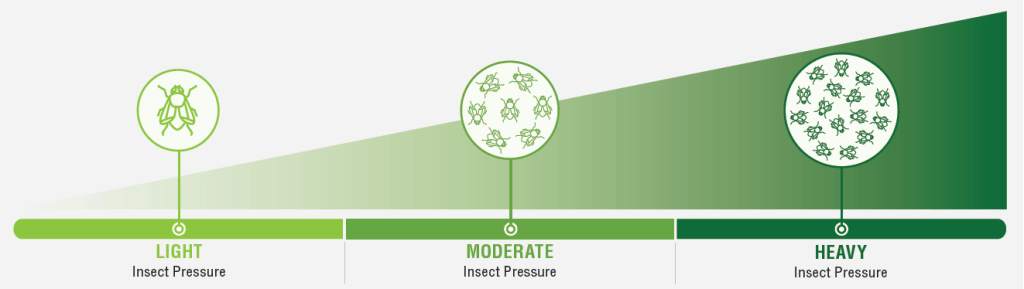
Not every livestock or poultry operation experiences the same level of flying insect pressure. Insect populations fluctuate throughout the season based on temperature, moisture, sanitation, animal density and surrounding breeding sites. A product that performs well under light insect pressure may not provide the same level of control when insect populations increase dramatically. Rather than relying on a single insecticide for every situation, selecting a product based on insect pressure can help optimize performance.
Limited Over-Animal Rotation Options
Unlike premise treatments, over-animal insect control products offer fewer options for rotating insecticide classes. Insecticides are classified by their mode of action, or how the active ingredient affects its target site to control an insect. Pyrethrins and permethrin are among the most used active ingredients for over-animal insect control. Although they are different active ingredients, they are both classified as IRAC Group 3A. As a result, producers often rely on the same mode of action throughout the season to control insects. Selecting products formulated with a synergist can help support insecticide performance as insect pressure increases and resistance concerns become more important.
More Active Ingredient Is Not Always Better
It is easy to assume that products containing higher concentrations of active ingredient will provide better insect control. However, product performance depends on more than the amount of insecticide in a formulation. Factors such as synergists, formulation technology, application method and insect pressure all influence product performance. As a result, product selection should be based on more than higher active ingredient concentrations alone.
What is Piperonyl Butoxide?
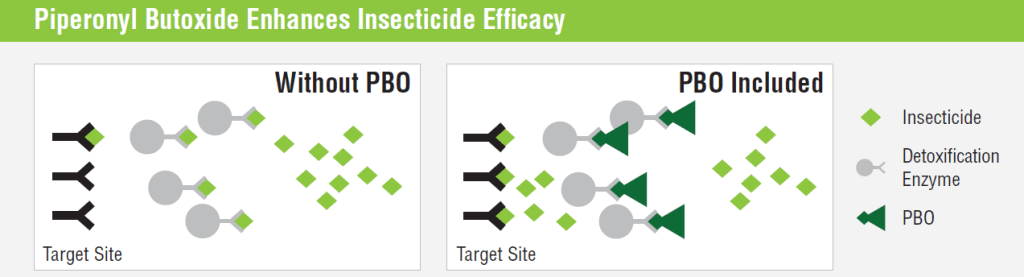
Because rotation options for over-animal applications are limited, maximizing the performance of each application is important. Piperonyl butoxide (PBO) is a synergist that enhances the performance of insecticides such as pyrethrins and permethrin. Many insect populations produce detoxification enzymes (cytochrome P450 enzymes) that begin breaking down insecticides before they reach their target site. PBO temporarily inhibits these enzymes, allowing more active ingredient to reach the insect nervous system and improving overall efficacy. As insect pressure increases or resistance begins to develop, products formulated with additional PBO may help improve insecticide performance and support more effective insect control.
Matching Products to Insect Pressure
MGK offers a range of over-animal insect control products formulated with varying active ingredients and levels of PBO to address different levels of insect pressure. Selecting the appropriate product depends on insect pressure, application method and treatment objectives.
- Light Insect Pressure: During periods of routine insect activity, products formulated with lower levels of PBO, such as Sector® Misting Concentrate, may provide effective insect control.
- Moderate Insect Pressure: As insect pressure increases, products with additional synergist support or multiple active ingredients may help improve insect control. Riptide® Waterbased Pyrethrin ULV, Troika® Misting Concentrate, Troika® Pour-On and ULD® BP-100 Contact Insecticide II provide additional support for managing changing insect pressure.
- Heavy Insect Pressure: Under heavy insect pressure or when insect populations become more challenging to manage, products formulated with higher levels of PBO, such as EverGreen® Pro 60-6, may help maintain effective insect control under demanding conditions.
Choosing Between Oil- and Water-Based Formulations
In addition to insect pressure and PBO levels, formulation type is another important consideration when selecting an insecticide. Water based formulations provide broad coverage, leave minimal residue on treated surfaces and are generally easier to clean from application equipment after use. Oil-based formulations provide longer suspension times and improved adhesion to animal hides, hair and feathers. When switching between water- and oil-based formulations, thoroughly clean application equipment according to the equipment manufacturer’s recommendations to help maintain application performance. Understanding the different formulations can help ensure the appropriate product is selected for the application site, equipment and treatment objectives.
Beyond Product Selection
While selecting the appropriate insecticide is important, it is only one part of an effective integrated pest management (IPM) program. Routine inspection, monitoring and sanitation should guide treatment decisions, including selecting products that align with current insect pressure and treatment objectives. Repeated use of the same mode of action can increase selection pressure, making rotation an important component of resistance management. Because over-animal applications offer fewer rotation options than premise treatments, incorporating additional tools, such as insect growth regulators (IGRs) when appropriate, and selecting products formulated to optimize insecticide performance can help reduce reinfestation, manage resistance and maintain effective insect control over time.
 Products
 Search